As everyone knows, confirming the phase system of the input and output voltages is crucial when customizing switchgear, as it affects the equipment’s efficiency and safety. 220V can be either single-phase or three-phase, depending on the national standard, power distribution system, and application scenario. This article will guide you through the selection and determination of the 220V phase system.
Voltage Overview
Voltage, simply put, is the potential difference between two points in a circuit, and it’s the driving force that propels the flow of electric current. Its essence is the energy difference per unit of charge flowing.
Comparison of Voltage Structures in Different Regions:
Regions | Single-Phase | Three-Phase | Frequency |
China | 220V | 380V | 50Hz |
Europe | 230V | 400V | 50Hz |
| North America | 120V/240V | 208V/480V | 60Hz |
Middle East | 220-240V | 380-415V | 50Hz |
| Saudi Arabia | 127/220V | 400V | 60Hz |
| Africa | 220/230V | 380/400V | 50Hz |
What Is 220V Single-Phase?
Definition:
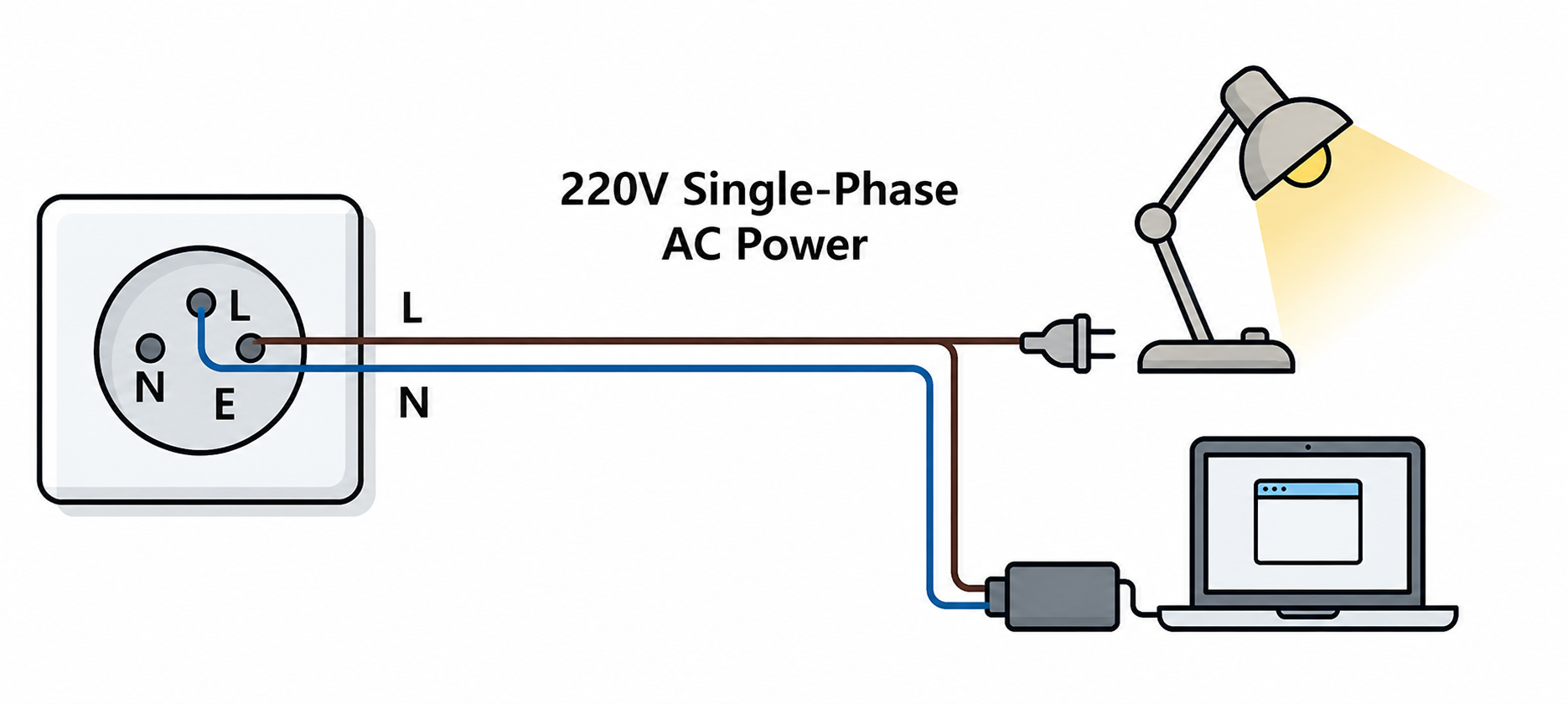
A single-phase 220V system consists of one live (L) conductor and one neutral (N) conductor, with an optional protective earth (PE) conductor. The voltage between L and N is 220V. It is commonly used in residential and light commercial applications.
Working Principle:
220V single-phase power consists of one (L) wire carrying 220V and one (N) wire forming a circuit. When an appliance is connected to (L) and (N), the voltage difference between these two wires creates a current circulation, allowing your appliance to operate normally.
In North America, a split-phase power supply system is commonly used, typically consisting of L1 and L2 wires with 110V voltage superimposed to form a 220V + (N) wire, a single-phase three-wire system.
In most other regions, the standard single-phase voltage between the live and neutral wires is 220–240V.
Application:
In the switchgear and distribution panel industry, 220V single-phase is suitable for lighting, air conditioning, small motors, and household distribution board. If your project is only for low-power household applications, single-phase power is suitable.
What Is 220V Three-Phase?
Definition:
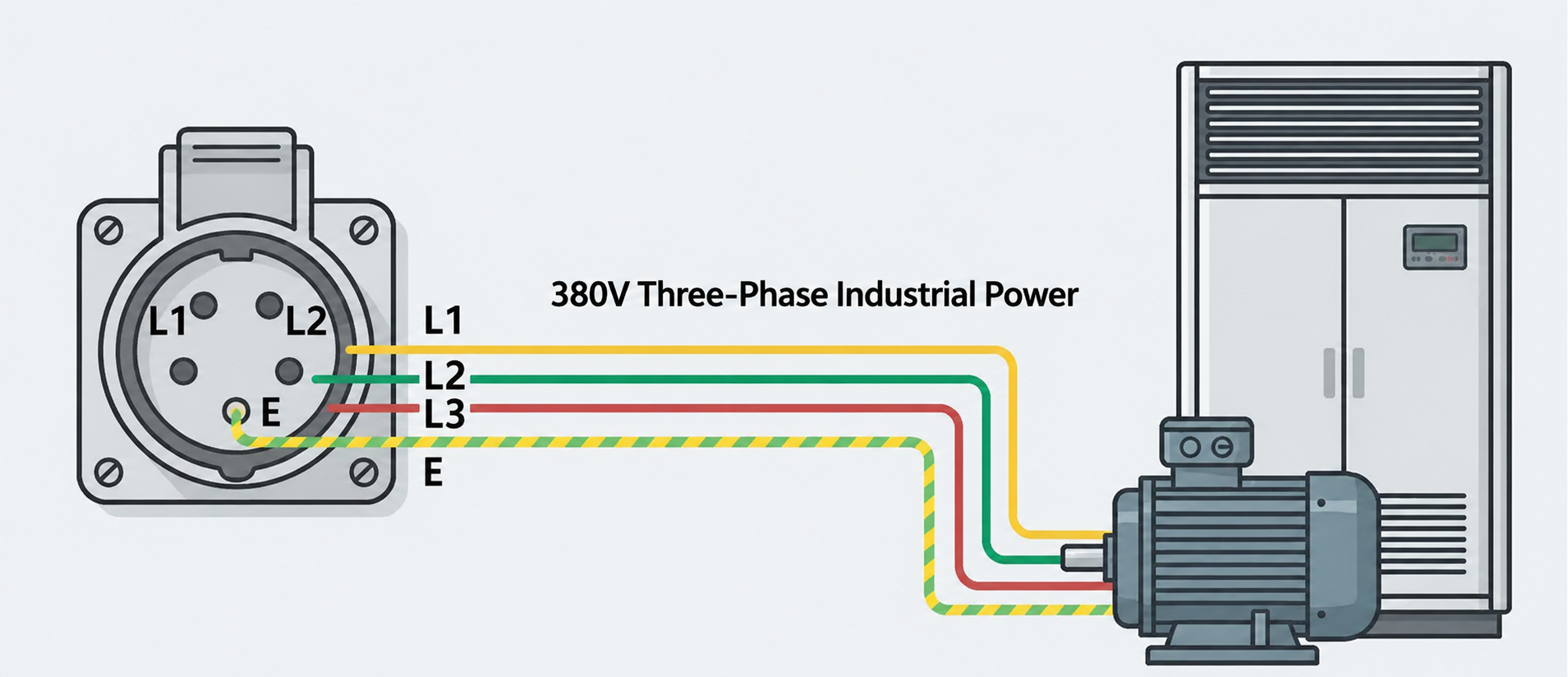
In a three-phase system, the phase voltage (phase line to neutral line) in a star connection (Y connection) is typically 220V per phase and 380V or 400V between any two phases.
Working Principle:
Three-phase AC power is generated as three voltages of equal magnitude and frequency, separated by 120° in phase. Because a three-phase system naturally creates a rotating magnetic field, it provides higher transmission efficiency and more stable power delivery than a single-phase system.
In a standard IEC star-connected (Y) three-phase four-wire system, L1, L2, and L3 phase conductors and a neutral conductor (N) are typically used. The phase voltage (L-N) is usually 220–230V, while the line voltage (L-L) is typically 380–400V.
Application:
In electrical switchboard and power distribution projects, high-power power distribution scenarios typically use three-phase systems. It is typically used in industrial plants, commercial facilities, motor control systems, and low-voltage switchgear.If your project involves high-power power distribution, a three-phase power supply is the better option.
Comparison Between Single-Phase and Three-Phase
Number of Conductors
Single-phase: Typically 2 or 3 wires (L1, L2, N)
Three-phase: Typically 3 or 4 wires (L1, L2, L3, N)
Voltage Measurement
Single-phase: 220V between wires
Three-phase: 220V relative to N, 380V between wires
Energy Consumption and Energy Efficiency
In terms of efficiency, three-phase systems are better than single-phase systems, especially in industrial environments. Because the three-phase current is distributed across three identical wires, it reduces line losses, helping to lower operating costs, reduce energy consumption, and is more energy-efficient and environmentally friendly.
Comparison of Single-Phase and Three-Phase Electricity
Item | Single-Phase | Three -Phase |
Phase Number | 1 phase | 3 phase |
| Circuit Composition | L + N | L1+L2+L3(A neutral wire can be added)) |
Power Supply Stability | Pulsating, unstable | Stable and continuous |
Power Supply Capacity | Slightly small | High load, high capacity |
Typical Applications | Residential/home use | High efficiency, high torque |
Motor performance | Low starting torque | High efficiency, high torque |
Cost | Even lower | High |
Transmission efficiency | Lower | High |
Power distribution system complexity | Simple | Complex |
Safety protection requirements | Simple | More complex |
| Expansion capability | Limited | Better |
Comparison of Single-Phase/Three-Phase Equipment
Equipment Type | Recommended Power Supply Type |
Lighting Equipment | Single-Phase |
Air Compressors | Three-Phase |
Industrial Motors | Three-Phase |
| Residential Distribution Boxes | Single-Phase |
Lighting equipment and household distribution boxes should preferably use single-phase power. These devices generally have low power consumption, primarily serving as household lighting, indoor lamps, and everyday household loads. Single-phase 220V wiring is simple, and the associated distribution boxes are less expensive, fully meeting daily usage needs.
However, processing machinery, water supply equipment, and high-power industrial motors are power-type loads with high operating power and high starting current, requiring three-phase power. Three-phase power provides ample output power and stable operating torque, ensuring smooth start-up and shutdown of high-power equipment, reducing line losses and voltage fluctuations, making it the standard power distribution solution for industrial power equipment.
In short,for low-power residential power distribution projects, you can choose single-phase power supply; for high-power industrial power equipment, you can directly choose matching three-phase power distribution.
How Switchgear Works in Single-Phase and Three-Phase Systems
| Item | Single-Phase | Three-Phase |
| Voltage | 220V | 380V / 10kV / 35kV |
| Wiring / Circuit | L+N+E | 3 Live, Neutral & Earth |
| Circuit Breaker | 1-pole | 3-pole |
| Power | Small | High |
| Protection Functions | Basic overcurrent and earth leakage | Overcurrent, differential, earth fault, arc protection |
| Tripping Mode | Trip single pole | Trip all three poles simultaneously |
Why does 220V can be single-phase and three-phase?
220V is a globally accepted AC effective value specification in power distribution systems, and it is not exclusive to single-phase power supply. 220V can exist in both single-phase and three-phase power supply systems.
Single-phase and three-phase are two different power supply structures, the specific type depending on the system wiring structure, voltage reference point, and actual application scenario. The difference lies not in the numerical value of 220V itself, but in how the 220V voltage is generated.
How to Choose Whether 220V Is Single-Phase or Three-Phase?
Factors You Should Consider:
Equipment parameters:
You need to select the switchgear circuit phase system according to the equipment nameplate display, ensuring that parameters such as power supply voltage and number of phases correspond correctly;
Load characteristics:
When your equipment load is a heavy-duty motor load, prioritize selecting a three-phase switchgear;
Efficiency requirements:
Three-phase systems have higher power density and better operating efficiency. If efficiency is a requirement, choose three-phase.
Cost considerations:
You need to consider the project environment requirements, comprehensively weighing the initial investment and long-term operation and maintenance costs to decide whether to choose single-phase or three-phase.
Regulatory requirements:
Because the requirements for electrical equipment vary from country to country, you need to strictly comply with local electrical regulations and industry standards when selecting switchgear parameters.
Consequences of Selecting the Wrong Phase System:
Equipment damage
Connecting three-phase equipment to a single-phase power supply, or vice versa, will burn out motors and electrical control components;
Insufficient performance
If your equipment is intended for an industrial environment, a single-phase system switchgear will not be able to power heavy-duty industrial equipment;
Efficiency loss
Phase system mismatch will reduce power efficiency and increase operating costs;
Safety hazards
Incorrect phase system wiring can easily lead to electrical accidents such as leakage and short circuits in the switchgear.
FAQ
Why is 220V Often Classified as Single-Phase Electricity?
When you see two (L) terminals, do you think it’s single-phase or three-phase? Actually, this is a single-phase boost connection method. Its voltage is higher than ordinary household voltage, but it’s still essentially single-phase. Because 220V only uses one (L) and one (N) terminal, it only uses one phase of a three-phase power supply, so it’s often classified as single-phase.
Can single-phase and three-phase electricity be converted to each other?
Yes. Three-phase to single-phase (power extraction): Standard wiring can be used directly without frequency converters, inverters, or other power conversion equipment. The mainstream connection methods are (L+N) and (L1+L2), and the specific selection should be based on local power distribution standards. The power distribution circuit needs to be equipped with appropriate electrical protection components.
Single-phase to three-phase (phase conversion): This cannot be achieved by simply connecting wires; it requires specialized equipment such as frequency converters, inverters, and phase converters.
What is the voltage difference between 220V single-phase electricity and 380V three-phase electricity?
220V single-phase electricity refers to the voltage between the live and neutral wires, while 380V three-phase electricity refers to the voltage of any two phases in a three-phase system.
Can a 220V three-phase motor run on single-phase power?
No, it cannot be used directly. Doing so will damage the motor. A frequency converter or phase converter is needed to convert the three-phase power to single-phase.
Can a switchgear support both 220V single-phase and three-phase power simultaneously?
Yes, it can. The main circuit is generally three-phase 220V/380V, while the control circuit is generally 220V single-phase.
What problems will occur if a three-phase motor is connected to a single-phase power supply?
This will cause the three-phase motor to fail to start or run normally, or to operate abnormally with unstable speed. Simultaneously, abnormal current will occur, the motor body will overheat severely, eventually burning out the coils, causing tripping or even a fire risk.
Final Thought
The phase system for 220V single-phase and 220V three-phase power supply is not fixed and is flexibly determined based on the actual operating conditions of your project. Zhongshao Electric can provide global customers with single-phase/three-phase power supply solution selection, as well as customized configuration services for switchgear that meets IEC standards and North American UL891 certification, based on local power grid standards and project requirements.